




Corporate Law-Related Blog Posts

Legal updates, regulatory guidance and practical perspectives for businesses operating in complex industries.

  • Corporate Law-Related Blog Posts

    Do Canadian Companies Need Local Directors, Officers or Shareholders?

    Understanding Residency Requirements for Key Roles of a Corporation in Canada Minimum Resident Canadian Director Quotas When setting up a corporation in Canada, whether federally or provincially, there are specific rules about who can be a director, particularly concerning residency. For federally incorporated companies, the general rule under the Canada Business Corporations Act (CBCA) is that at…

  • Corporate Law-Related Blog Posts

    What Ledgers and Registers Does a Canadian Corporation Need?

    Core Corporate Records Mandated by Statute Under Canadian law, specifically the Canada Business Corporations Act (CBCA), corporations are legally obligated to maintain certain foundational documents. These records form the bedrock of the company’s existence and governance, and their proper upkeep is not merely good practice but a statutory requirement. Failure to maintain these documents can lead to…

  • Business Law-Related Blog Posts

    Asset Purchase Agreements

    Legal Services for Asset Purchase Agreements in Canada An Asset Purchase Agreement (APA) is one of the most common legal agreements used when purchasing or selling a business. Unlike a share purchase, where ownership of a corporation changes hands, an asset purchase generally allows the purchaser to acquire selected assets while leaving many historical liabilities…

  • Business Law-Related Blog Posts

    How To Buy Shares in a Private Canadian Corporation

    Basics of Obtaining Share Ownership of a Company in Canada Defining A Shareholder And Share Ownership A shareholder is essentially an owner of a corporation. When you buy shares, you’re acquiring a piece of that company. These shares represent your ownership interest and, depending on the class of shares, can come with various rights. In…

  • Corporate Law-Related Blog Posts

    How To Sell Shares in Your Corporation

    Understanding Share Sales in Canadian Corporations When you decide to sell your Canadian corporation, you generally have two main paths: selling the company’s assets or selling the company’s shares. Most often, the person selling prefers to sell the shares. This is usually because it can lead to better tax outcomes, particularly with the way capital…

  • Corporate Law-Related Blog Posts

    How To Transfer Shares in a Company

    Understanding Share Transfers in Canadian Corporations Defining Share Ownership and Shareholder Status In Canada, owning shares in a corporation means you hold a piece of that company. This ownership grants you specific rights and responsibilities. When you acquire shares, you become a shareholder, which is a formal status within the corporate structure. The articles of…

  • Corporate Law-Related Blog Posts

    How to Issue Shares In Your Own Corporation

    Share Issuance Basics for Companies in Canada Issuing shares is a fundamental step in the life of a Canadian corporation, representing the sale of ownership stakes. When your corporation issues shares, it’s essentially selling pieces of itself to investors in exchange for capital. This capital can then be used to fund operations, expansion, or other…

  • Contracts-Related Blog Posts

    10 Clauses To Include In A Commercial Contract To Protect You

    Know Just Some Of The Provisions To Put In Your Company’s Agreements To Protect Its Interests 1. Payment Terms When you’re setting up a business deal, getting the payment terms right is pretty important. It’s not just about the total amount; it’s about when and how that money changes hands. Clear payment terms prevent a lot of headaches down…

  • Corporate Law-Related Blog Posts

    What Documents Should Be In a Corporate Minute Book?

    Basics of the Corporate Minute Book Definition and Purpose of a Minute Book A corporate minute book is essentially the official diary of a company. It’s a collection of all the vital legal and governance documents that chart the corporation’s journey from its inception to its current operations. Think of it as the company’s memory,…

FAQ

Your Question Answered.

Have questions about Substance Law? Here are some of the most common queries to help you get started.

  • Timelines depend on the licence type, how complete the application is and the regulator’s current processing times. We prepare the application and supporting documents so the review runs smoothly, and we give you a realistic timeline at the start.

  • It depends on the services you provide. Money services businesses register with FINTRAC, and payment service providers performing retail payment activities register with the Bank of Canada under the RPAA. Some businesses need both; we review your model and tell you which apply.

  • In many cases, yes. A transfer is approved by the provincial regulator and depends on the licence conditions, the premises and the buyer’s eligibility. We handle the filings and coordinate with the other side of the deal.

  • It depends on the product, its claims and how it is sold. Some products are regulated as drugs or natural health products by Health Canada. We review the product and the sales model and explain what is permitted.

  • Yes. We advise clients across Canada on federal and provincial regulatory matters, and we coordinate with local counsel where a provincial rule requires it.

  • We always strive to offer our clients transparent, flexible and reasonable pricing and payment options. Where the scope of the engagement permits, we try to offer our clients innovative, fixed-fee pricing options instead of traditional hourly rates, and payment through EFT, Wire, E-transfer, and Credit/Debit Card.

Service areas / Jurisdiction

Ontario-Based.
Canada-Wide Expertise.

We advise clients across Ontario and throughout Canada on regulatory, licensing and compliance matters in cannabis, psychedelics and other regulated industries.

  • AGCO Licensing

    Cannabis retail, consumption and related licensing

  • Municipal Licences

    Zoning, land use and local approvals

  • Smoke-Free Ontario Act

    Compliance and enforcement matters

  • Federal Licensing

    Health Canada, Canada-wide regulatory matters

  • Excise and Tax

    CRA, excise, FINTRAC and related requirements

  • Other Regulated Industries

    Psychedelics, hemp, wellness and emerging sectors

Our Offices

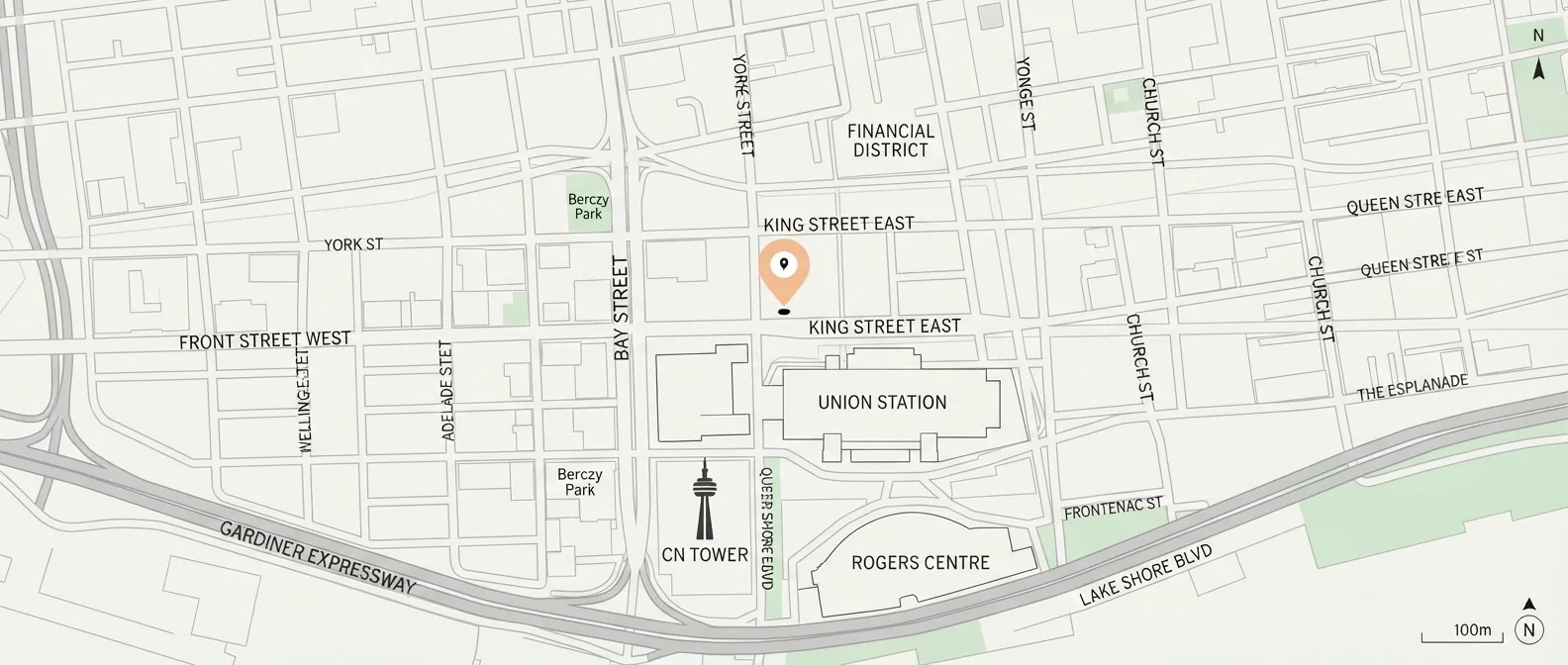
Map of the Toronto office

Our Office

10 King Street East, Suite 600

Toronto, ON M5C 1C3

Get directions

Office hours

Monday - Friday

9:00 AM - 5:00 PM (EST)

+1 647-371-0032

Contact

Get Strategic Counsel. Now.

You want to move fast, and you're looking for a law firm equipped to handle your challenges. That's where we fit in.

  • Book a Consultation Schedule a time that works for you.
  • Flexible Options Transparent pricing and fixed-fee options available.
  • Quick Response Typically within one business day.
  • Confidential Your information is always private.

Takes about 60 seconds · No commitment

Tell us what you need

    Canada's Law Firm For Regulated Substances